Research
What I work on, in plain language.
Physics
New CMS triggers for long-lived particles using Muon Detector Showers
2022 – present
A signature is only usable if the trigger keeps it. Dedicated hardware triggers on muon detector showers were developed and commissioned for LHC Run 3, so that events containing a decay inside the muon system are recorded rather than discarded in the first microseconds of the readout chain.
Long-lived particle searches with Muon Detector Showers
2020 – present
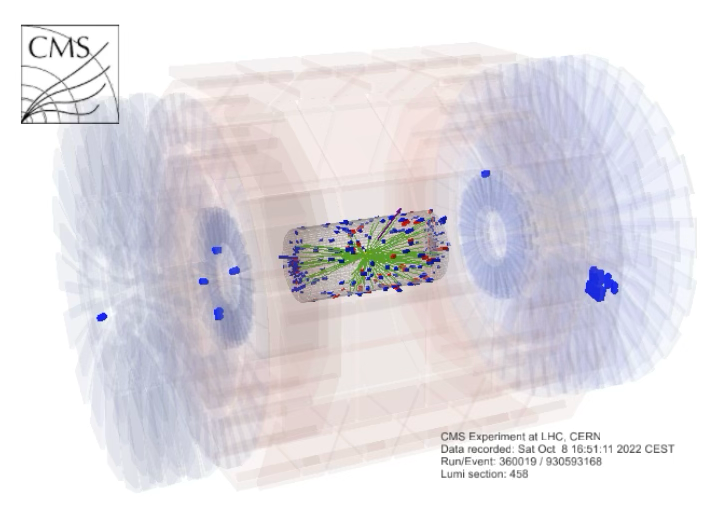
Long-lived particles that decay inside the CMS muon detectors deposit a dense cluster of hits — a muon detector shower — rather than the isolated tracks conventional reconstruction is built to find. Treating that shower as a signal in its own right opens a region of parameter space the experiment was previously blind to. Using this signature, CMS set the world's best limits on low-mass, long-lived heavy neutral leptons.
Fast machine learning on ASICs
2019 – 2020
- Designed a quantized autoencoder network to compress HGCAL front-end electronics data, capable of ultra-low-latency on-detector inference
Boosted Higgs decaying into bottom quarks
2019 – 2020
- Performed the inclusive search for Higgs decaying to bottom quarks using boosted jet substructure and machine learning; published in JHEP
CMS HCAL online software and DAQ
2016 – 2018
- Developed Run Control features allowing concurrent commissioning of HCAL detector partitions during the phase-1 upgrade
- Built monitoring tools for debugging HCAL phase-1 front-end communication issues
Searches for microscopic black holes and sphalerons
2016 – 2018
- Performed the first dedicated experimental search for electroweak sphalerons with CMS data; published in JHEP
Computing
GPU portability for high energy physics reconstruction
2021 – present
HEP reconstruction code now has to run on GPUs from several vendors without being rewritten for each. Working within the HEP-CCE Portable Parallelization Strategies team, this line of work ports real CMS reconstruction — HCAL energy reconstruction, pixel and track finding — onto portability layers such as Alpaka and Kokkos, and benchmarks the result on NVIDIA, AMD and Intel hardware to measure what portability actually costs in performance and in developer effort.